
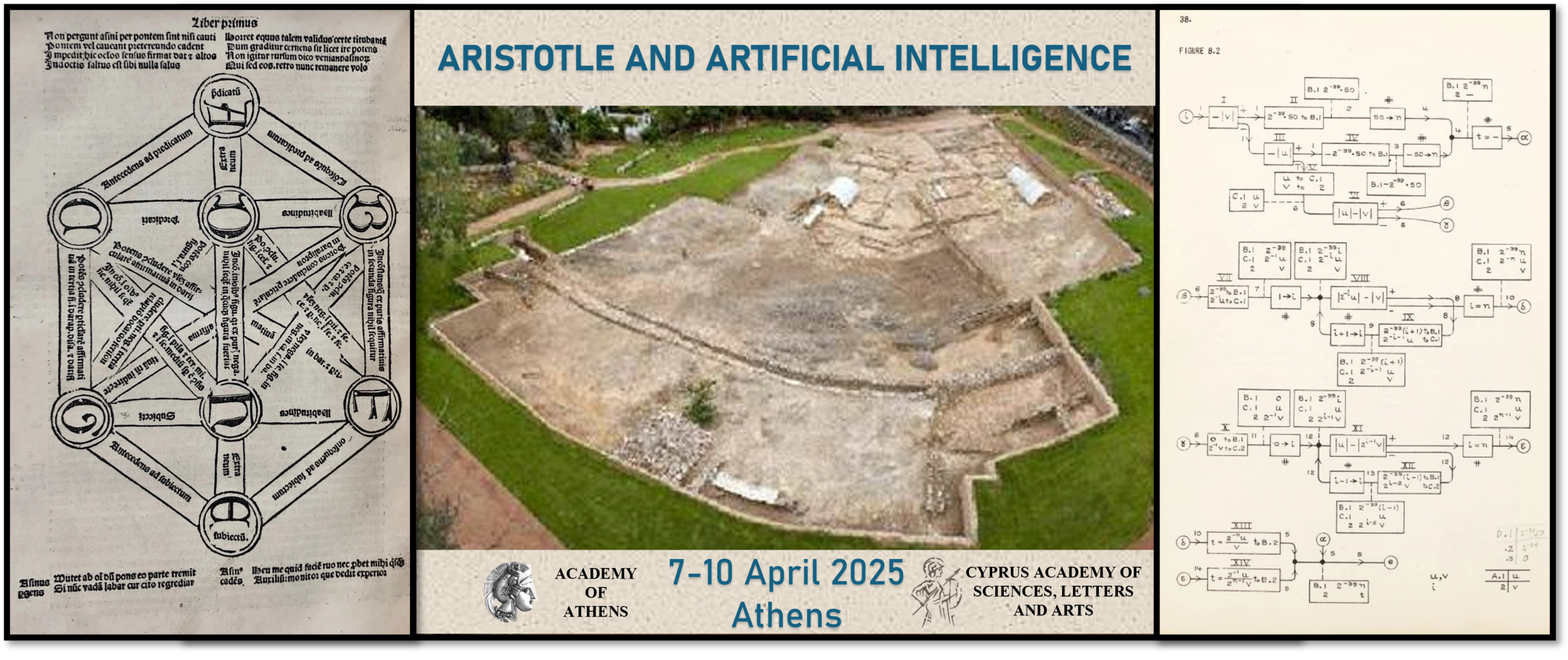
ARISTOTLE IN THE ERA OF ARTIFICIAL INTELLIGENCE
The Academy of Athens together with the Cyprus Academy of Sciences, Letters and Arts are organizing an International Conference on Aristotle and Artificial Intelligence to be held at the premises of the Athens Academy during the period of 7-10 of April 2025.
Could Aristotle, the first thinker on the systemization of human thought, be considered today as one of the forefathers of the thinking machines of Artificial Intelligence? Much emphasis has been put over the years on his conception of strict logical reasoning, but his wider notion and methods of dialectic argument can arguably provide a foundational understanding of the nature of human thinking and how this relates to our individual and social lives. Notwithstanding his systematic study on the validity of arguments, his understanding of logical reasoning can be seen to permeate within his investigation of many other matters, whether this is scientific enquiry, ethical behaviour or political governance. Nonetheless, the possible relation between Aristotle’s conception of human thought and the emergence of thinking machines remains in statu nascendi.
The conference will explore these foundational links of Aristotle’s ideas on logical reasoning and the practice of reasoning in human endeavours, to the concept, design and utilization of AI thinking machines. It aspires to examine Aristotle over a wide spectrum of his possible relevance to AI, ranging from the underlying building blocks of AI on methods of learning and reasoning, to the metaphysics of knowledge and science, to the morality of thinking machines. Already we have studies of the link between Aristotelian Ethics and AI Ethics (amongst them is the Lyceum Project of AI Ethics with Aristotle with a meeting held in Athens in June 2024), proposing novel approaches for the regulation of AI and the synthesis of AI entities into the human society. The conference will have an emphasis on Aristotle’s ideas on the computational aspects of reasoning and its practical application and their relevance to AI. As such, it will also include a special workshop on the computational aspects of Aristotle’s Syllogistic logic.
The nature of the conference is intended to be explorative. By bringing together Aristotelian scholars and other researchers with links to Artificial Intelligence, the conference aims to provide an environment where the potential role of Aristotle to AI can be explored and oriented.
VENUE
Academy of Athens
LOCATION (Academy of Athens Main Building)
Panepistimiou 28, 106 79, Athens, Greece
INVITED SPEAKERS & PARTICIPANTS FOR THE WORKSHOP
ABSTRACTS (PDF)
Kevin Baragona (CEO DeepAI): Deep Learning in AI.
George Chatzivasileiou (Philosopher of Technology [PhD, AUTH], Author of “Philosophy of AI”, Journalist): Who owns the Future?
Edgar Daylight (Lecturer / Universität Siegen & Lille University): The Interplay of Aristotelianism and Platonism in Nondeterministic Computations.
Silvia Fazzo (Professor / Università del Piemonte Orientale): Aristotle, the Single Intellect, and Artificial Intelligence.
Petros A. M. Gelepithis (Adjunct Faculty Member / University of Crete)
Sara Greco (Associate Professor of Argumentation / University of Lugano): What is the place of the Aristotelian logos in conflict prevention and resolution in our contemporary poleis?
George Karamanolis (Associate Professor / University of Vienna)
Colin G. King (Associate Professor of Philosophy / Providence College): Consistency tests with τόποι.
Marko Malink (Professor of Philosophy & Classics / New York University): The Metaphysical Basis of Aristotle’s Logic.
Zoe McConaughey (Associate Professor of History and Philosophy of Logic / University of Lille): A formal reconstruction of Aristotle’s assertoric syllogistic.
Vincent C. Müller (Professor in the Philosophy and Ethics Group / Eindhoven University of Technology): Is reasoning overrated? Some indications from recent philosophy of AI and cognition.
Josiah Ober (Professor of Political Science / Stanford University): The future of AI: Sophisticated tool or self-conscious agent? Plato and Aristotle on “Why not both”? [co-speaker: Voula Tsouna]
Spyridon Rangos (Professor of Ancient Greek Literature and Philosophy / University of Patras): Aristotle’s Intellect as Excellence of Life and Understanding.
Christof Rapp (Professor of Ancient Philosophy / University of Munich): How to program the dialectic machine.
Voula Tsouna (Distinguished Professor of Philosophy / UC Santa Barbara): The future of AI: Sophisticated tool or self-conscious agent? Plato and Aristotle on “Why not both”? [co-speaker: Josiah Ober]
Internal keynote speakers:
Andreas Demetriou (Cyprus Academy of Sciences, Letters and Arts): Is Aristotle enough for Artificial General Intelligence?
Athanassios Fokas (Academy of Athens): Can AI Reach Human Thought?
Christos Papadimitriou (Academy of Athens / Columbia University): Aristotle, Artificial Intelligence and the Human Brain.
Prokopios Pavlopoulos (Academy of Athens): Τα όρια της Τεχνητής Νοημοσύνης κατά την απονομή της Δικαιοσύνης. (The limits of Artificial Intelligence in administering Justice)
Internal Contributors:
Alexander Nehamas (Academy of Athens / Princeton University)
Kyriakos Demetriou (Cyprus Academy of Sciences, Letters and Arts): Beyond Consciousness: AGI and the “Impartial Spectator”.
Antonis Kakas (University of Cyprus): Aristotle’s Original Idea: For and Against Logic in the Era of AI.
Doukas Kapantais (Academy of Athens): Is There a Robust Argument for Thinking as a Quale?
CALL FOR PARTICIPATION – ACCEPTED ABSTRACTS
Researchers interested in participating at the conference and/or the workshop can do so by submitting a short abstract of maximum 1000 words, including references (this is a strict limit) on how Aristotelian ideas relate to their conception of AI or to their work on AI. Abstracts should be submitted as a pdf file electronically at aristotle.ai@academyofathens.gr and aristotle.ai@ucy.ac.cy by the 7th of January 2025. Together with the submission of abstract prospective participants are asked to fill in the following Form of Interest to participate and submit this together with their abstract.
Selected abstracts will be included in the program of the conference via a 20-30 minute presentation and/or through participation in the open panel discussions of the conference.
Selected abstracts:
Sebastian Bücker (Technical University of Darmstadt): Why Artificial Phrónesis might be Computationally Infeasible.
Leonidas Chiotis (University of York): Can Artificial Ethical Assistants Enhance Human Decision-Making in Virtue Ethics?
John Dudley (UCLouvain): The Relevance of Aristotle’s Thought to the Understanding of AI.
Silvia Fazzo (Università del Piemonte Orientale): Aristotle, the Single Intellect, and Artificial Intelligence.
Petros A. M. Gelepithis (University of Crete): The scope and limits of AI in relation to Aristotle’s work and Earthian evolution.
Sevcan Gugumcu (UCLA): Artificial Intelligence, Philosophical Argumentation, and Aristotle’s Ontological Taxonomy.
Martin Hinton (University of Lodz): Machine Ethos: the Goodwill, Virtue, and Wisdom of the Artificially Intelligent.
Caterina Kanavari (Hellenic Open University), Giorgos Sfikas (University of West Attica): Ο Αριστοτέλης στην εποχή του ΑΙ: Από τη διαλεκτική του είναι και της νόησης στην Camera obscura και τις αυτόματες μηχανές.
Maciej Kulik, Katarzyna Budzynska, Medea Kfoczynska-Lukasz, Katarzyna Michalowska (Faculty of Administration and Social Sciences, Warsaw University of Technology): Aristotelian approach to hateful speech moderation.
Christos Kyriakou (University of Cyprus): Aristotle’s Phronesis and Normative Algorithmic Computability.
Fran O’Rourke (University College Dublin): Aristotle and Artificial Intelligence.
Narjes Sheikh Asadi (Università della Svizzera Italiana): Can AI Learn to Annotate the Heart of Inference Correctly?
Bartłomiej Skowron, Jarosław Chudziak (Warsaw University of Technology): Toward a Benevolent LLM: Exploring Aristotle’s Concept of Benevolence.
Filippos Stamatiou, Sandrine Hansen (University of Copenhagen): Who is the Slave? Reflections on Human Nature in the Age of AGI.
Karol Wapniarski (Adam Mickiewicz University, Poznań, Poland): Aristotelian Virtue Ethics as an Impasse-Resolver for the Discussion Surrounding Autonomous Vehicles.
PROGRAM
Program on the 7-10 April, 2025
7th April
18:00 – 21:30: Opening Session
18:00 – 18:20: Welcome: Michael Tiverios, President of the Academy of Athens
Welcome address by C.S. Zerefos, Academy of Athens
Welcome address by A. C. Emilianides, Cyprus Academy of Sciences, Letters and Arts
18:20 – 18:50: Prokopios Pavlopoulos (Academy of Athens): Τα όρια της Τεχνητής Νοημοσύνης κατά την απονομή της Δικαιοσύνης (The limits of Artificial Intelligence in administering Justice)
19:00 – 19:30: Andreas Demetriou (Cyprus Academy of Sciences, Letters and Arts): Is Aristotle enough for Artificial General Intelligence?
19:40 – 20:10: Christos Papadimitriou (Academy of Athens): Aristotle, Artificial Intelligence and the Human Brain
20:10 – 20:40: Open Discussion with the three Keynote speakers
20:40 – 21:30: Cocktail Reception (Hellenic Society on Artificial Intelligence / ΕΕΤΝ)
O9:30 – 15:30: Pons Asinorum workshop
This is a closed session with participation only by invitation. The results of this workshop will be presented at the main program of the conference.
8th April
09:15 – 09:30: Welcome by the Organizers
09:30 – 10:30: How to program the dialectic machine? (Christof Rapp, University of Munich)
10:30 – 11:00: Tea/Coffee Break
11:00 – 12:30: Presentation of Abstracts.
Why Artificial Phrónēsis Might Be Computationally Infeasible
(Sebastian Bücker, TU Darmstadt)
The Relevance of Aristotle’s Thought to the Understanding of AI
(John Dudley, UCLouvain)
Aristotle’s Phronesis and Normative Algorithmic Computability
(Christos Kyriacou, University of Cyprus)
Aristotle, the Single Intellect, and Artificial Intelligence
(Silvia Fazzo, Università del Piemonte Orientale)
12:30 – 13:30: What is the place of the Aristotelian logos in conflict prevention and resolution in our contemporary poleis? (Sara Greco, USI Università della Svizzera italiana)
13:30 – 15:30: Lunch
15:30 – 16:30: The Metaphysical Basis of Aristotle’s Logic (Marko Malink, New York University)
16:30 – 17:00: Tea/Coffee Break
17:00 – 18:00: Panel Discussion 1: The future of AI: Sophisticated tool or self-conscious agent? – Plato and Aristotle on “Why not both”?
Alexander Nehamas, Academy of Athens
Josiah Ober, Stanford University
Voula Tsouna, University of California / Santa Barbara
18:15 – 19:30: Is There a Robust Argument for Thinking as a Quale? (Doukas Kapantais, RCGPh, Academy of Athens)
Aristotle’s Intellect as Excellence of Life and Understanding (Spyridon Rangos, University of Patras)
9th April
09:15 – 10:15: Philosophy of AI and Aristotle: Who owns the Future? (George Chatzivasileiou, Author of “Philosophy of AI”)
10:15 – 11:45: Presentation of Abstracts.
The scope and limits of AI in relation to Aristotle’s work and Earthian evolution
(Petros A. M. Gelepithis, University of Crete)
Can Artificial Ethical Assistants Enhance Human Decision-Making in Virtue Ethics?
(Leonidas Chiotis, University of York)
Can AI Learn to Annotate the Heart of Inference Correctly?
(Narjes Sheikh Asadi, Università della Svizzera Italiana)
Who is the Slave? Reflections on Human Nature in the Age of AGI.
(Filippos Stamatiou & Sandrine Hansen, University of Copenhagen)
11:45 – 12:15: Tea/Coffee Break
12:15 – 13:00: Beyond Consciousness: AGI and the “Impartial Spectator”
(Kyriakos Demetriou, Cyprus Academy of Sciences, Letters and Arts)
13:00 – 13:45: Deep Learning in AI (Kevin Baragona, CEO of DeepAI)
13:45 – 15:15: Lunch
15:15 – 16:00: Is reasoning overrated? Some indications from recent philosophy of AI and cognition (Vincent Müller, University of Erlangen-Nürnberg)
16:00 – 17:00: Panel Discussion 2: But can they actually think?
Vasso Kindi, University of Athens
Vassilis Katsouros, Athena Research Center
Vincent Müller, University of Erlangen-Nürnberg
Moderated by Antonis Kakas, University of Cyprus
17:00 – 17:30: Tea/Coffee Break
17:30 – 18:45: Presentation of Abstracts
Machine Ethos: The Goodwill, Virtue, and Wisdom of the Artificially Intelligent
(Martin Hinton, University of Lodz)
Aristotle and Artificial Intelligence
(Fran O’Rourke, University College Dublin)
Aristotelian Virtue Ethics as an Impasse-Resolver for the Discussion Surrounding Autonomous Vehicles
(Karol Wapniarski, Adam Mickiewicz University)
20:00 : Conference’s dinner
10th April
09:15 – 10:30: Presentation of Abstracts
Aristotle and AI: From the dialectics of being and thought to reflecting on automata and the camera obscura
(Caterina Kanavari, Hellenic Open University & Giorgos Sfikas, University of West Attica)
Aristotelian approach to hateful speech moderation
(Maciej Kulik, Katarzyna Budzynska, Medea Kfoczynska-Lukasz, Katarzyna Michalowska, Warsaw University of Technology)
Toward a Benevolent LLM: Exploring Aristotle’s Concept of Benevolence
(Bartłomiej Skowron & Jarosław Chudziak, Warsaw University of Technology)
10:30 – 11:15: Consistency tests with τόποι (Colin Guthrie King, Providence College)
11:15 – 11:45: Tea/Coffee Break
11:45 – 12:30: The Interplay of Aristotelianism and Platonism in Nondeterministic Computation (Edgar Daylight, KU Leuven)
12:30 – 13:15: A formal reconstruction of Aristotle’s assertoric syllogistic (Zoé McConaughey, Lille University)
13:15 – 14:00: Can AI Reach Human Thought? (Athanassios Fokas, Academy of Athens)
14:00 – 14:15: Closing Session
Report from the Workshop on Pons Asinorum
Summary Report of the Meeting
Companion to “Aristotle and AI”
Next Conference
14:15 – 15:15: Lunch
NEWS
27 March 2025
Dear All,
We are now close to the start of the meeting and we would like to update you on some details.
Firstly, we have updated the final program of the meeting. As you will see, we have a busy schedule with nearly 30 presentations.
The meeting starts on Monday the 7th at 6pm. This will be the “formal opening” of the meeting with three short talks and a short discussion to follow. You are all welcome to this, so please arrive at the Academy between 5:30- 5:50pm.
As this is an “exploration” meeting, all talks will be followed by a discussion. Invited talks will have a 15 min discussion and abstract presentations a 5 min of question/answer. Furthermore, there will be two panel discussion sessions where all participants are encouraged to put questions to the panelists.
For any further information please send an email to aristotle.ai@academyofathens.gr and aristotle.ai@ucy.ac.cy.
Best wishes,
Kyriakos Demetriou, Antonis Kakas and Doukas Kapantais
CONTACTS
For further enquiries, please contact a member of the organizing committee:
Kyriakos Demetriou (Professor at the University of Cyprus, Member of the Cyprus Academy of Sciences) – k.demetriou@ucy.ac.cy
Antonis Kakas (Professor at the University of Cyprus) – antonis@ucy.ac.cy
Doukas Kapantais (Research Director at the Centre for Greek Philosophy at the Academy of Athens) – dkapa@Academyofathens.gr
Συνημμένα έγγραφα
- DOCX: ParticipationForm-2024-5
- PDF: Wapniarski – Aristotelian Virtue Ethics as an Impasse-Resolver
- PDF: Stamatiou, Hansen -Who is the Slave in the Age of AGI 0125
- PDF: Skowron, Chudziak – Toward a Benevolent LLM
- PDF: Sheikh Asadi – Can AI Learn to Annotate the Heart of Inference Correctly
- PDF: O'Rourke – Aristotle and Artificial Intelligence
- PDF: Kyriakou-Aristotle's Phronesis and Normative Algorithmic Computability
- PDF: Kulik et al. – Aristotelian approach to hateful speech moderation
- PDF: Kanavari, Sfikas – Ο Αριστοτέλης στην εποχή του ΑΙ
- PDF: Hinton-Machine Ethos
- PDF: Gugumcu-Artificial Intelligence, Philosophical Argumentation, and Aristotle’s Ontological Taxonomy
- PDF: Gelepithis – Aristotle, AI, Evolution
- PDF: Dudley – The Relevance of Aristotle's Thought to the Understanding of AI
- PDF: Chiotis-Can Artificial Ethical Assistants Enhance Human Decision-Making in Virtue Ethics
- PDF: Bucker – Why Artificial Phrónesis might be Computationally Infeasible
- PDF: Fazzo S. – Aristotle, the Single Intellect, and Artificial Intelligence
- PDF: AbstractsOfInvitedandInternal